Iranpolymer/Baspar In the field of high-performance engineering, success is rarely achieved by materials alone; it’s the expertise behind them that makes the difference.
ALBIS, a global distributor of thermoplastic materials, goes beyond material distribution by offering deep technical service and co-engineering support. Its collaboration with the Metz Racing Team (MRT) in the Formula Student competition illustrates how technical know-how and material science contribute directly to advancing lightweight and mobility solutions.
A TECHNICAL PARTNERSHIP BEYOND MATERIAL SUPPLY
The French Engineering Association (FEA) organises the Formula Student France (FSF), an engineering competition with strong European visibility, aiming to promote hands-on engineering education in connection with low-carbon mobility solutions.
For MRT, every gram counts, every component matters and every decision impacts vehicle performance on the track. ALBIS’s role as a technical partner helped MRT select suitable materials and develop tailored engineering solutions.
This season, MRT focused on reducing vehicle weight while improving performance and safety. ALBIS proposed a series of material innovations and engineering insights that helped the team achieve its goals.
STEERING WHEEL: BALANCING STRENGTH AND LIGHTWEIGHT DESIGN
The steering wheel is the driver’s primary interface with the vehicle. It must endure rotational forces, mechanical stress and braking loads. MRT wanted to develop a lightweight yet structurally sound design.
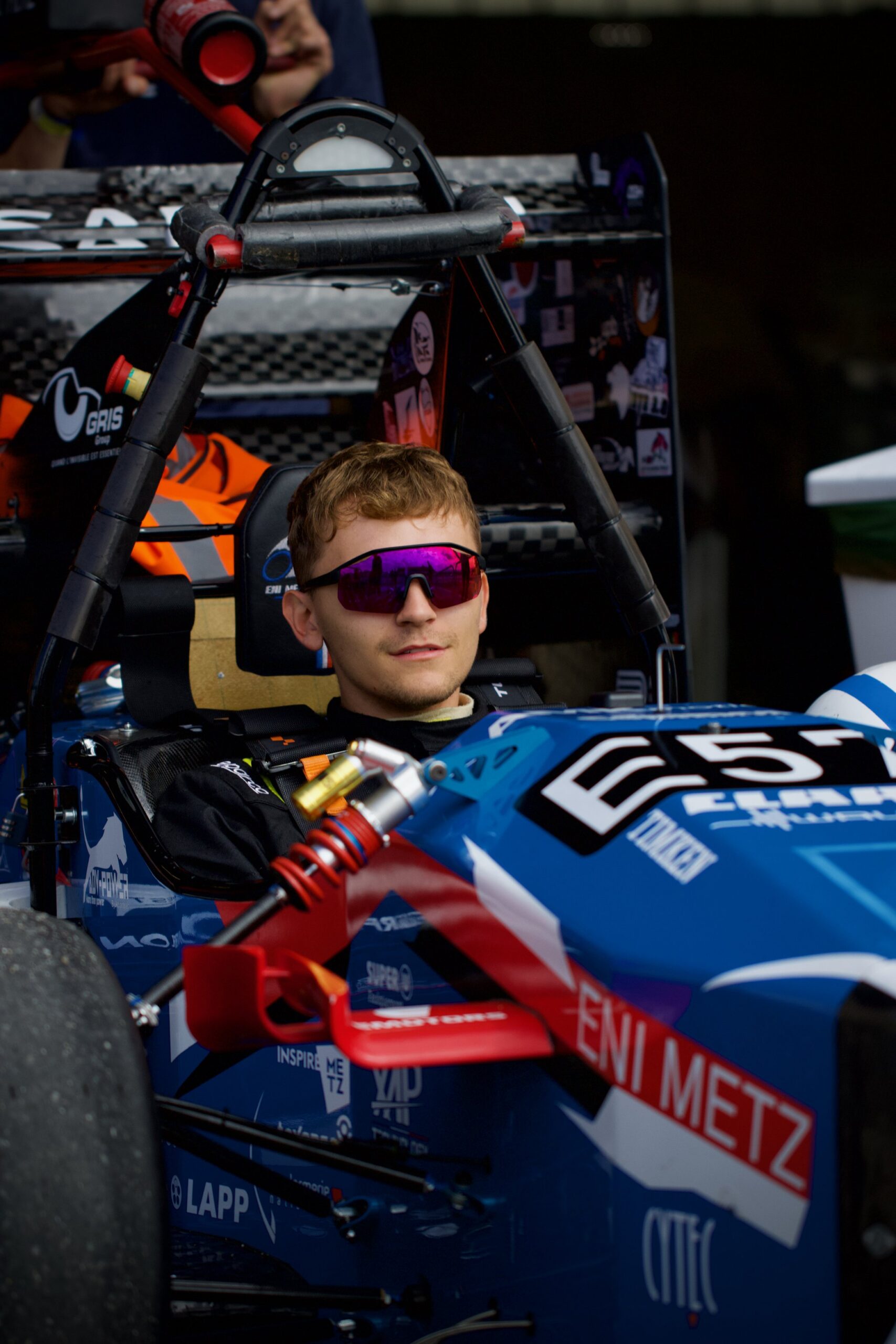
Nathan Kannengiesser (image left), Team Manager Metz Racing Team, explains, “We worked with ALBIS to identify an engineering plastic capable of withstanding these stresses while being easy to machine. ALBIS carried out an in-depth study, including computer-based finite element analysis (FEM), to assess the material’s mechanical strength.”
The chosen material, MOCOM WIC PA6 30, polyamide reinforced with recycled carbon fibre, offered the perfect balance of strength, safety and sustainability. The FEM analysis showed minimal deformation under 1000 N of force, confirming its suitability.
Rory Chandler, Business Development Manager at ALBIS, continues, “This project reflects responsible design, reducing weight while using low-CO2 equivalency materials. It’s a great example of how engineering plastics can replace metal in structural applications.”
WING MOULDS – LIGHTWEIGHT AND RELIABLE
For the aerodynamic components, precision and repeatability are essential in composite manufacturing. Previous moulds made from foam or wood lacked the required heat resistance and surface quality. Nathan explains, “These materials didn’t provide the quality or stability needed for curing at 100°C.”
The team has since switched to a more advanced process using pre-impregnated resin (or “pre-peg”), followed by vacuum bagging and thermal curing. To enable this, MRT collaborated with ALBIS to identify a material that could withstand the baking temperatures, was easy to machine and remained dimensionally stable during curing without deformation.
ALBIS recommended WIC PP 30 BK from MOCOM, a polypropylene reinforced with recycled carbon fibre. This lightweight engineering plastic combines high strength with thermal resistance. With a density of just 1.07 g/cm3, it’s significantly lighter than aluminium or steel, yet offers a tensile modulus of 13,000 MPa and a VICAT temperature of 125 °C.
Rory notes, “This material made the moulds easier to handle and improved the quality of the final composite parts.” Nathan adds, “The solution chosen was to machine the negative shapes of the wing directly into blocks of engineering plastic (WIC PP 30 BK) supplied by ALBIS, and then to drape directly into these moulds.”
This process significantly improved the precision of the composite parts obtained, as well as the surface finish, while also making the manufacturing process more consistent and reliable.
TSAL SYSTEM: BETTER VISIBILITY AND SAFETY
The Tractive System Active Light (TSAL) is an essential safety feature that indicates the presence of high-voltage electricity in the vehicle. Previously, MRT used a transparent plastic plate with LEDs, which lacked track-side visibility and, consequently, aesthetic appeal. Nathan points out, “This system revealed the interior and the light were not well diffused, which was detrimental to aesthetics and legibility.”
ALBIS proposed materials from the Makrolon DQ range by Covestro, engineered for optimal light diffusion. These offer a balanced combination of transmission and diffusion, ensuring a clear and uniform illuminated appearance.
Nathan explains, “We were able to test an opaque material specially designed for improved light diffusion. Several samples were provided, and one was cut out with a water jet, then installed on the vehicle.”
Rory adds, “We supported MRT through testing and selection. The final choice provided excellent diffusion and met all technical requirements.”
COLLABORATION AS A DRIVER OF INNOVATION
The partnership between ALBIS and the Metz Racing Team highlights the impact of technical expertise in material selection and engineering.
Rather than standardised deliveries, the focus was on individual consultation, testing and application-driven solutions. This project demonstrates how close collaboration can accelerate innovation in lightweight design and mobility engineering.
interplasinsights