Iranpolymer/Baspar The K 2025 International Exhibition, held from October 16 to 23, 2025, in Düsseldorf, Germany, once again stood as the world’s largest and most influential exhibition for the plastics and rubber industries. For eight days, the Messe Düsseldorf fairgrounds became the global epicenter of polymer innovation, where machinery manufacturers, material producers, and technology developers showcased their latest achievements.
This year’s K Fair was not only a stage for unveiling advanced machinery and production lines but also a turning point in the presentation of intelligent systems, precision instruments, and self-learning software. The halls of Düsseldorf painted a vivid picture of a future where the boundaries between machines, data, and human decision-making were gradually fading.
This transformation was structured around three core concepts: intelligent monitoring, modular automation, and process data integration—a path that was steering factories from being mere producers toward becoming self-learning and adaptive systems.
Artificial Intelligence in Process Monitoring and Control
Among the participating companies, ENGEL, Arburg, KraussMaffei, and Haitian showcased the next generation of digital assistants and self-learning algorithms. ENGEL’s iQ assistance systems were present at several levels of the injection molding process—from real-time adjustment of injection pressure to automatic adaptation of mold temperature and robotic arm speed.
These systems collected real-time data from in-line sensors, analyzed variations in viscosity, temperature, and pressure, and then recommended optimal parameter settings. The results were enhanced process stability, reduced waste, and consistent product quality.
Similarly, Arburg, through its ALS system, demonstrated a platform that stored and analyzed data from multiple production lines in an integrated environment. The software evaluated part quality concurrently with production and enabled immediate intervention whenever deviations from process limits were detected.
Smart Tooling and Mold Systems
In the tooling sector, the transformations were equally remarkable. Companies such as Kistler, HASCO, and Priamus presented systems that effectively blurred the line between tools and sensors.
For example, Kistler’s ComoNeoPURE was introduced as a quality monitoring system for injection molding, capable of analyzing the injection curve via in-mold pressure and temperature sensors and identifying deviations in real time. The recorded data were stored directly in the production database and communicated with the control system to automatically adjust machine parameters.
HASCO, on the other hand, introduced a new generation of modular tooling systems that allowed for rapid component exchange, in-mold monitoring of temperature and pressure, and automatic calibration. These tools were connected to the factory network via standardized digital interfaces and played an active role in AI-based analytical models for learning process behavior.
Advanced Robotics and Human–Machine Synergy
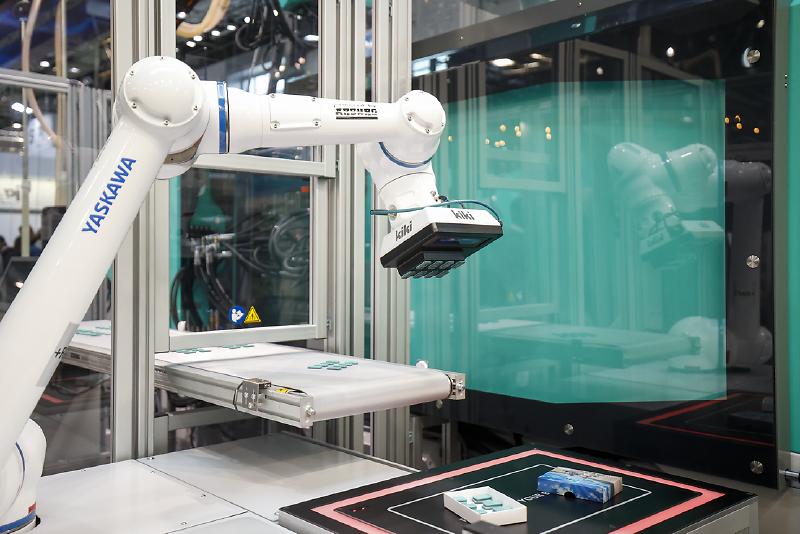
In the robotics domain, brands such as Stäubli and Wittmann demonstrated a new level of coordination between humans and machines.
Stäubli’s six-axis robots, equipped with joint torque sensing capabilities, were now able to operate collaboratively with human technicians, responding adaptively to human presence and position.
In parallel, Wittmann’s WX Series robots, featuring the new R9.2 control system, incorporated real-time monitoring of energy consumption, downtime, and line efficiency, while maintaining direct communication with the injection molding machine. The robots’ motion and positional data were integrated into MES systems, generating a comprehensive map of the production environment and operational status.
Data Analytics and Predictive Decision-Making
With the growing volume of sensor-generated data, real-time analytics had become a critical element of modern manufacturing. In this area, companies such as BMSvision and Gefran played significant roles.
BMSvision introduced its OptiMon AI suite at K 2025, which calculated a Quality Index for each production cycle through the combined analysis of machine data and image recognition. This index enabled predictive decision-making regarding mold replacement or production line shutdowns before quality deviations occurred.
Similarly, Gefran presented the Sensormate Load Monitor system, capable of real-time monitoring of mold clamping force and providing instant alerts in case of anomalies. The system’s data were stored in the Gefran IoT Platform cloud environment, where they were used to train AI models for predicting the mechanical behavior of molds during operation.
Integrated Software and Digital Factory Platforms
Companies such as Siemens, Beckhoff, and Ewon focused on data infrastructure, forming the backbone of the industry’s digital transition.
At K 2025, Siemens introduced its Opcenter Execution for Plastics platform as a centralized hub for production data integration. This system unified data from machine-level controls to quality analysis within a single environment, enabling transparent and synchronized production management.
Beckhoff, leveraging its TwinCAT Analytics environment, reconstructed machine behavior in a digital space, providing a foundation for predictive process monitoring and diagnostics. In parallel, Ewon Flexy emerged as the standard tool for remote support, secure data transfer, and automatic event logging, gaining visibility across multiple booths throughout the fair.
From Tooling to Learning: The Path Toward Self-Learning Factories
The convergence of these technologies indicated that K 2025 was no longer merely a machinery exhibition, but rather a living laboratory for the industry’s transition toward self-learning factories.
In this new landscape, every system—from molds and sensors to software and robotics—acted as a node within a real-time data network that continuously learned to optimize processes, predict quality outcomes, and manage energy consumption.
The plastics industry, once heavily dependent on human experience, was now building systems that learned autonomously, made decisions independently, and self-corrected through continuous feedback.
With its focus on artificial intelligence, digital transformation, and intelligent tooling, K 2025 effectively paved the way for the entry of manufacturing into the era of Cognitive Automation.